 March 26th, 2026

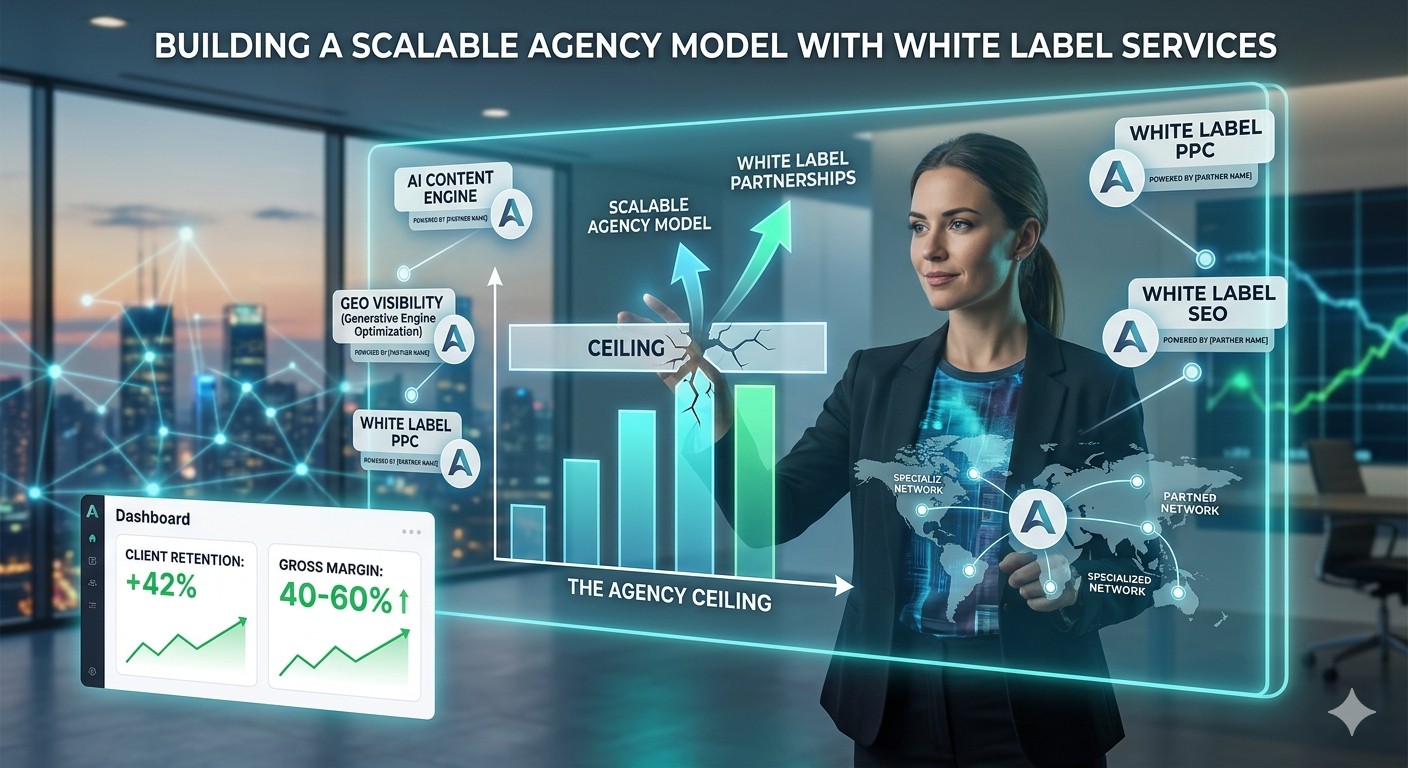
he “Agency Ceiling” is a real place, and it’s usually paved with burnout, missed deadlines, and the constant, nagging fear of hiring a full-time specialist you can’t quite afford yet.
In 2026, the landscape has shifted. We are no longer just fighting for “clicks”; we are fighting for visibility in AI Overviews, optimizing for Generative Engine Optimization (GEO), and managing complex, multi-channel campaigns that would make a 2020 agency owner’s head spin.
The secret to breaking through that ceiling? It’s not “working harder.” It’s White Label Services. —
What Does White Labeling Look Like in 2026?
White labeling isn’t just “outsourcing” anymore. It is a strategic partnership where a third-party provider executes high-level work—SEO, PPC, AI-driven content, or even complex app development—under your brand.
Your client sees your logo, your reports, and your strategy. Behind the curtain, a specialized powerhouse handles the heavy lifting. With the white label market projected to hit $99 billion by the end of 2026, it’s clear that the “do-it-all-in-house” model is becoming a relic of the past.
The 2026 Power Moves:
- Generative Engine Optimization (GEO): White label partners are now specializing in getting your clients cited by AI agents like ChatGPT and Perplexity.
- Fractional Expertise: Instead of hiring one mid-level generalist, you’re “renting” fractional access to world-class data scientists and niche specialists.
- Outcome-Driven SLAs: The focus has shifted from “completing tasks” to “driving revenue.” Modern partners sign off on measurable business impact.
Why Scale with White Labeling?
If you’re still on the fence, let’s look at the cold, hard numbers. Recent data shows that agencies outsourcing 40–60% of their delivery grow 2.3 times faster than those trying to keep everything in-house.
1. Scale Without the HR Headache
Hiring is risky. Between salaries, benefits, and the 3-month “ramp-up” period, a bad hire can sink a small agency. White labeling allows you to turn capacity on and off like a faucet. You only pay for what you use, and you never have to worry about a “capacity wall.”
2. Instant Niche Authority
Want to offer “AI-Powered Predictive Analytics” but your current team is strictly creative? You don’t need to spend six months learning it. Partner with a white label specialist and you can go to market tomorrow with a battle-tested service.
3. Margin Magic
Traditional agencies often struggle with 15–20% margins because of high overhead. White label SEO and PPC packages in 2026 are frequently yielding 40–60% gross margins. You’re effectively buying expert labor at wholesale and selling it at a premium.
How to Build the Model (Without Losing Your Soul)
Scaling an agency this way requires a shift in mindset. You are no longer a “doer”; you are a Strategic Architect.
Step 1: Identify Your “Core” vs. “Context”
- Core: Your client relationships, high-level strategy, and brand voice. This stays in-house.
- Context: The technical execution, 24/7 ad monitoring, and backend reporting. This goes to the white label partner.
Step 2: Vet for Transparency, Not Just Price
In 2026, a “cheap” partner is a liability. Look for:
- Real-time Dashboards: If you have to wait 30 days for a PDF report, they’re living in 2018.
- Agentic AI Integration: Are they using AI to make their fulfillment faster and more accurate?
- Clear Ownership: Ensure you own the data and the accounts.
Step 3: Manage the “Seam”
The biggest risk is the “gap” between your account manager and the partner’s execution. Treat your white label partner as a department of your own company. Give them access to your Slack (or your AI collaboration hub) and include them in the strategy phase, not just the “do this” phase.
The Future: From Efficiency to Growth
The agencies thriving right now aren’t using white labeling just to “cut costs.” They are using it to deliver better results. When you have a specialized team handling the technical nuances of 2026’s search algorithms, your clients stay longer. In fact, agencies leveraging white label services report 42% higher client retention rates.
The “Hustle Culture” of the 2010s told us to do everything ourselves. The “Scalable Culture” of 2026 tells us to build a network of experts.
The bottom line: Your clients don’t care who pushed the buttons; they care that the buttons moved the needle.