
 July 15th, 2026

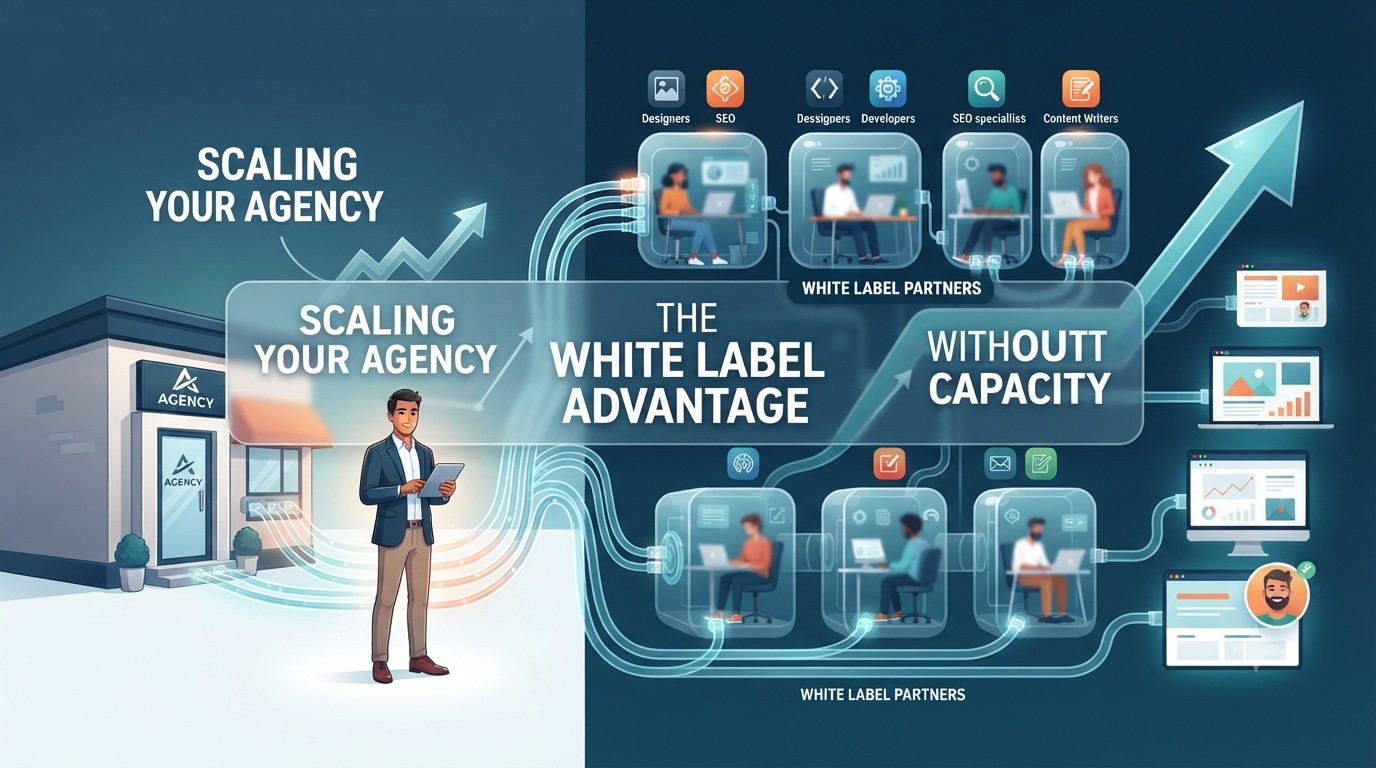
For most agency owners, growth feels like a double-edged sword. You win three new retainers, and the celebration lasts until the realization hits: your team is at capacity.
The traditional “fix” hiring more full-time staff—is often the biggest trap in the agency world. It introduces fixed costs, recruitment headaches, and training cycles that can grind your momentum to a halt. When business slows down, you are left carrying that payroll, turning your profit margin into a liability.
There is a smarter way to scale. It’s called the White Label model, and it is rapidly becoming the secret weapon of high-growth agencies.
What is White Labeling?
At its core, white labeling is the practice of partnering with an external specialist firm to execute work that is then delivered under your agency’s brand.
Unlike traditional outsourcing, where you might hire a freelancer whose work you have to heavily manage and quality-check, a white label partner acts as an extension of your team. The end client never sees the partner; they see your logo, your report, and your strategist.
Why the “Hire-or-Decline” Dilemma is Obsolete
Scaling by hiring is rigid. Scaling by white labeling is fluid. Here is why the shift is necessary:
| Feature | In-House Hiring | White Label Partnership |
| Cost Structure | Fixed (Salary + Benefits + Overhead) | Variable (Pay-per-project/retainer) |
| Agility | Slow (Months to hire/train) | Instant (Access to experts immediately) |
| Risk | High (Staff turnover, underutilization) | Low (Contractual SLAs) |
| Focus | Managing internal HR/culture | Focusing on growth, sales, and strategy |
4 Strategic Benefits of the White Label Model
1. Instant Service Expansion
Want to offer SEO, advanced web development, or paid media, but lack the technical expertise in-house? A white label partner gives you immediate access to a deep bench of specialists. You can add new service lines to your agency proposal overnight without having to undergo the “learning curve” of building those departments from scratch.
2. Predictable Margins
When you hire, profit margins are volatile. A bad month with low billables still requires you to pay salaries. White labeling converts these fixed costs into variable ones. You know exactly what your fulfillment costs are for every project, allowing you to set firm, profitable pricing that is protected from overhead creep.
3. Focus on “The Agency Core”
Agency owners often get stuck in the “fulfillment trap” spending their days managing projects rather than closing deals or refining the agency’s vision. By offloading technical execution to a trusted partner, you reclaim the time to focus on what actually grows your business: high-level client strategy, sales, and networking.
4. Flawless Brand Consistency
A quality white label partner doesn’t just do the work; they adopt your processes. They follow your reporting templates, use your communication style, and adhere to your brand guidelines. To the client, the work is yours, because the output is consistent with the standard they expect from you.
How to Get Started: The “Safe Start” Roadmap
If you are ready to stop scaling by payroll and start scaling by partnership, follow these steps:
- Identify the Gaps: Look at your project list. Which tasks are causing the most burnout? Which client requests are you currently turning down because you “don’t have the bandwidth”?
- Define Your Criteria: Don’t just look for the cheapest provider. Look for partners with clear Service Level Agreements (SLAs), proven QA processes, and a willingness to integrate into your preferred project management tools (like Slack, Notion, or ClickUp).
- Audit the Workflow: Before handing over a client account, run a “shadow project.” Have the partner perform work for your own internal agency assets to ensure their quality and process align with yours.
- Start Small: Pick one service line or a single client account to test the partnership. Once you are satisfied with the communication and the quality of output, expand the engagement.
Final Thoughts: Growth Without the Friction
Scaling doesn’t have to mean building a massive office or managing a giant payroll. The most successful agencies in 2026 are the ones that act as the strategic hub, while leveraging a network of specialized partners to handle the “how” of execution.
By decoupling your capacity from your headcount, you create an agency that is built for speed, profitability, and, most importantly, sustainability. Stop hiring for capacity start partnering for growth.
Are you currently managing a team that is reaching its breaking point, or are you looking to expand your service offerings without adding to your overhead?